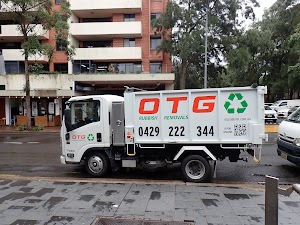
Liquid paint cannot go in a household bin, down a drain or into a skip in Sydney. Take it to a Paintback site (no charge, up to 100 litres a visit in containers of 20 litres or less), a Community Recycling Centre or a Household Chemical CleanOut event. Whether empty or dried-out tins can be binned depends on your council.
A note on who we are: OTG Rubbish Removals is a private, paid rubbish removal company. We do not run Paintback sites, council recycling centres or CleanOut events, and we cannot book one for you. Every drop-off below costs a household nothing, and for a handful of tins it beats paying us. This is the paint chapter of our guide to disposing of common household items.
Read the clean-up line on the label. If brushes wash out in water, the paint is water-based. If the label calls for mineral turpentine, it is oil-based, also called solvent-based.
Paintback sends solvent-based paint to energy recovery and separates water-based paint into liquid and solids. That is why the Community Recycling Centre at Artarmon asks you to separate oil-based from water-based tins before you arrive, and why Paintback wants paint unmixed, in the container it was sold in.
The NSW EPA counts paint as a household problem waste and says these products “require special treatment and processing and cannot be placed in your bins”. The City of Sydney warns that chemicals in the red-lid bin can combust, or leak into soil and groundwater.
Drains are no better. Sydney Water says paint can harden inside plumbing and pollute rivers and the ocean. Street gutters run to stormwater, and Mosman Council states that it is illegal to put anything other than rain into that system, with fines for offences.
A skip does not get around it. The EPA’s landfill guidelines say liquid waste is not permitted to be landfilled in NSW, so a skip or trailer load with wet paint in it can be turned around at the tip. Our guide to Australian waste disposal regulations explains why whoever generated the waste stays responsible for where it ends up.
Households have three options that cost nothing. We checked each limit on the scheme’s own page on 17 November 2026.
| Paint product | Where it can go | Limits |
|---|---|---|
| House paint (water-based or oil-based), primers, undercoats, sealers | Paintback, Community Recycling Centre (CRC) or CleanOut event | Paintback: 100 litres per visit, containers up to 20 litres. CRC: household quantities, set by each centre. CleanOut: up to 100 litres of paint at certain events |
| Stains, shellacs, single-pack varnishes, deck and wood coatings | Paintback or CleanOut event | As above |
| Empty tins and tins of dried-up paint | Paintback. Household bin only where your council allows it | Counts toward the 100 litres by container size |
| Aerosol spray paint | CRC or CleanOut event. Not Paintback | Household quantities |
| Turps, thinners, solvents, paint stripper | CleanOut event. Not Paintback | 20 litres or 20 kilograms of a single item |
| Two-pack, automotive, anti-fouling and texture coatings | Not Paintback. Ask the host council before a CleanOut event | Household quantities |
| Trade and business quantities | Paintback or a commercial waste contractor. Not a CRC or CleanOut event | Paintback: 100 litres per visit |
Paintback is the paint industry’s own scheme, funded by a levy of 15 cents a litre on new paint. The 100 litres is measured by container size, not by what is left inside, so twenty-five 4-litre tins is a full visit even if each holds a centimetre of paint.
Hardware and paint shops do not take paint back: Paintback says retail outlets are not equipped or licensed to handle liquid waste. Sites are also sparse. The Paintback location finder showed four within 40 kilometres of the CBD when we checked, at Five Dock, Thornleigh, Kimbriki on the Northern Beaches and Liverpool. None is in the Eastern Suburbs or the city.
Community Recycling Centres are permanent, council-run drop-offs for households only. The EPA’s guide is a maximum container of 20 litres or 20 kilograms for each waste type, and centres set their own paint cap. Artarmon allows 20 litres of paint per customer per day, which is five 4-litre tins.
On our side of Sydney, the EPA’s finder lists centres at Artarmon, Matraville, St Peters, Leichhardt, Five Dock and Thornleigh. Most are open to any NSW resident. The EPA names Leichhardt as an exception, so check the centre’s own page before you drive.
CleanOut is the EPA’s drive-through collection, held on set dates. It takes paint and paint-related products, including the solvents the other two refuse. Events are infrequent in any one area: Northern Beaches Council lists its next local one for June 2027.
Sydney councils do not agree. These are the ones we checked.
For any other council, look up “paint” in its A to Z waste guide first. Paintback accepts empty tins and tins of dried-up paint, so they can travel with the rest.
Two councils mention it. Mosman says to let unused paint dry out and put the residue in the bin. Northern Beaches says to let it dry and then still take the tin to Kimbriki or a CleanOut event. Neither describes a method, and we found no EPA page endorsing hardeners or kitty litter, so we will not recommend one.
Stir it properly before deciding. Paint that has separated into a thin layer over thick pigment usually stirs back together. Paint that stays lumpy, has turned rubbery or smells sour is finished.
Good paint is better on a wall than in a drop-off cage. For full tins, Inner West Council suggests listing them on a local buy, sell or swap group.
Stains, shellacs, single-pack varnishes and deck coatings are on Paintback’s accepted list. Aerosols, thinners and solvents, two-pack coatings, automotive and anti-fouling paint, brushes, rollers and trays are not.
Spray cans with paint still in them go to a CRC or a CleanOut event. Inner West accepts emptied aerosol cans in the yellow bin. Turps, thinners and paint stripper belong at a CleanOut event. Keep each in its original container: the EPA warns never to mix chemicals.
Paintback is the only one of the three open to trade painters, at the same 100 litres per visit. CRCs and CleanOut events do not accept business waste, and the EPA directs businesses to a commercial waste contractor or the BusinessRecycling directory. Paintback says it is still working on a way to collect larger trade volumes. Building managers in the City of Sydney are asked to contact the council about quantities before a CleanOut event.
Count containers, not litres of paint. Forty 4-litre tins is 160 litres by Paintback’s measure, which means two visits, or eight trips at Artarmon’s daily cap. If a tin has lost its label, the EPA asks you to mark it “unknown chemical” and take it to a CleanOut event. Very old tins may hold lead paint, which Northern Beaches Council says Kimbriki will not accept, although its CleanOut events do.
This is where a paid pickup can make sense. On a garage clean-up or a shed clear-out we load the paint with everything else and deliver it to a facility licensed to take it, and you do not need to sort water-based from oil-based first. Our paint and paint tin removal page sets out what we take. Bulk drums of solvent, pool chemicals, pesticides, fuels and unlabelled containers are outside it, so mention them when you call, along with any small bottles of turps, thinners or paint stripper.
Not with liquid paint in them. Empty or dried-out tins depend on your council. Northern Beaches and Ku-ring-gai accept empty, dry tins in the yellow bin, and Inner West lists the red bin, the council clean-up or a Community Recycling Centre. Check your own council’s A to Z guide first.
No. Paintback states that unwanted paint cannot be accepted at retail or trade outlets unless otherwise specified, because shops are not equipped or licensed to handle liquid waste. Its drop-offs are purpose-built sites, mostly at council recycling centres. Use the location finder on the Paintback website.
Up to 100 litres per visit, in the original containers, none larger than 20 litres. The 100 litres is measured by container size, not the paint left inside. That is five 20-litre drums, ten 10-litre cans or twenty-five 4-litre tins.
No. Sydney Water says paint does not belong down the sink or drain because it can harden inside plumbing and pollute rivers and the ocean. Wipe brushes with a paper towel and bin the towel before rinsing, then take the sealed tin to a drop-off.
Yes, as a paid service. We collect paint and paint tins across Sydney and deliver them to a facility licensed to take paint. It suits a shed, garage or strata cupboard holding more tins than the drop-off limits allow. For a few tins, a drop-off costs you nothing. Nothing is collected for free.
If a drop-off will cover it, use the drop-off. If the shed holds more than a couple of car loads, tell us roughly how many tins there are and send a photo. The job is quoted up front before anything is loaded. Call 0429 222 344 or send us the details online.