Getting rid of a mattress in Australia means choosing between council bulk pickup (limited to one or two collections a year), donation (only if it’s genuinely clean), tip drop-off (DIY and needs a suitable vehicle), or booking a professional removal service. Skip bins can’t legally take whole mattresses. A recycled mattress is broken into springs, foam, and fabric — most of it stays out of landfill.
Key Takeaways
- Council bulk waste pickup is free but limited — usually once or twice a year per property.
- Donation only works if the mattress is clean, undamaged, and odour-free.
- Skip bins legally cannot accept whole mattresses — OTG cuts them on-site to make recycling possible.
- Up to 90% of mattress materials can be recovered when handled by a proper recycling service (Recycling Near You, 2023).
- Professional removal is the only hands-off option that guarantees compliant disposal.
Mattresses are one of the harder household items to dispose of correctly. For a full breakdown of other bulky items and how to handle them, see our guide to how to dispose of household items in Australia.
Mattresses are banned from standard household bins across Australia because of their size and the way they behave at landfill. Sustainability Victoria reports that Australians discard approximately 1.8 million mattresses every year (Sustainability Victoria, 2023), with the vast majority still ending up in landfill despite recycling options being available.
The physical problem is compaction. A mattress doesn’t compress well. It takes up enormous space in collection vehicles and creates structural problems at landfill when buried. Steel springs can damage equipment and puncture landfill liners.
The regulatory problem is just as real. Most Australian states classify whole mattresses as bulky waste, meaning they require a specific disposal pathway. Putting one out with your regular weekly rubbish is not a legal option in any major city.
Understanding what can and can’t go in a skip bin matters for mattress disposal specifically. Our comparison of rubbish removal vs skip bin hire covers this in detail.
Council bulk waste services are the most commonly used free disposal option, but they come with real limitations. The Australian Local Government Association notes that the majority of metropolitan councils offer bulk waste collection just once or twice per year per household (ALGA, 2022), meaning timing your disposal around the schedule isn’t always practical.
Most councils do include mattresses in their bulk waste lists. But rules differ significantly between areas. Some require online booking before you put anything out. Others run zone-by-zone collections on a set calendar. Placing a mattress kerbside outside your allocated window can attract a fine.
If your council collection is coming up soon and you have a single mattress ready to go, this is a cost-effective option. If you’re moving house, doing a clean-out, or your collection isn’t for months, it’s not practical.
Search your council’s name plus “bulk waste collection” on Google, or visit your council’s website directly. Most publish annual calendars by suburb or street zone. Some councils also offer a booking portal where you register your items before the pickup date.
Donating a mattress keeps it out of landfill entirely, but the bar is high. The National Association of Charitable Recycling Organisations (NACRO) reports that many Australian charities have tightened hygiene acceptance criteria significantly in recent years (NACRO, 2023), with mattresses being among the most commonly refused items.
A mattress must be in genuinely clean, undamaged condition to be considered. No stains of any kind, no tears or rips in the fabric, no odours, and no signs of pest damage. Charities that accept them apply strict standards because of public health obligations.
Even if the mattress looks fine to you, it’s worth calling ahead. Intake rules change frequently, and many charity stores have simply stopped accepting mattresses altogether in certain locations.
The Salvation Army and St Vincent de Paul are the most widely known options. Some community Facebook groups and platforms like Gumtree or Freecycle are worth trying if the mattress is in good shape. Always be upfront about the condition.
Most Australian council transfer stations (tips) accept mattresses from residents, often at little or no charge for one or two items. The Australian Bureau of Statistics found that around 53% of Australian households made at least one tip visit in the 2021-22 period (ABS, 2022), suggesting it’s a common and accepted route for bulky waste.
The practical requirement is transport. A mattress won’t fit in a standard car. You’ll need a ute, van, or trailer. If you’re already doing a general clean-out and hiring a trailer anyway, adding a mattress to the tip run makes sense.
Check your local tip’s rules before you load up. Some facilities require you to book for mattresses specifically, others have weight limits, and a small number charge a separate fee for mattresses.
Professional rubbish removal is the only completely hands-off option for mattress disposal. IBISWorld data shows Australia’s rubbish removal industry has grown steadily at around 3.4% annually as more households choose professional services over DIY disposal (IBISWorld, 2024).
The service covers collection from inside or outside your home, transport, and compliant disposal or recycling. You don’t need a vehicle, you don’t need to be on any council schedule, and it can usually be booked within a day or two.
For households removing multiple items alongside a mattress, it’s particularly practical. A single booking handles everything at once.
If you’re only getting rid of a mattress and nothing else, a single item rubbish pickup is the most straightforward way to do it.
This is one of the most common questions in mattress disposal, and the short answer is no — at least not in whole form. The Victorian Environment Protection Authority (EPA Victoria) and equivalent bodies in NSW and QLD all classify whole mattresses as a prohibited or restricted item in standard skip bins (EPA Victoria, 2023) because of compaction and contamination risks.
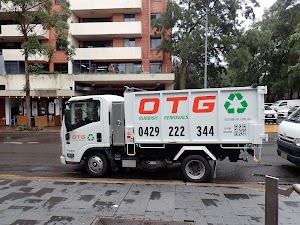
OTG’s difference: OTG cuts mattresses on-site before loading. By separating the steel springs, foam layers, and fabric covering, each material stream goes to the correct recycling facility. This is legal, it avoids landfill, and it’s something a skip bin simply cannot do. If you’ve been told a skip bin can take your mattress, ask them to confirm it in writing — most can’t.
This is a real and important distinction. Skips are a practical tool for many jobs, but mattress removal isn’t one of them. See our detailed breakdown of when to choose rubbish removal over a skip bin for the full comparison.
When a mattress is recycled properly, it’s broken into three distinct streams. Recycling Near You estimates that up to 90% of mattress materials are recoverable through this process (Recycling Near You, 2023), which is a significant improvement over sending the whole unit to landfill.
The innerspring unit is the heaviest component and the easiest to recycle. Steel is a high-value scrap material. It’s baled and sent to steel mills for reprocessing into new products.
Polyurethane foam and fibre filling are shredded and compressed. The most common end use is carpet underlay, which gives the material a second working life under new flooring installations.
The outer fabric is separated during disassembly. Depending on its condition and composition, it’s directed to industrial textile recycling or used as padding material in manufacturing applications.
You have four main options: council bulk waste pickup (limited slots per year), donating if the mattress is clean and undamaged, dropping it at your local tip yourself, or booking a professional rubbish removal service. Professional removal is the most convenient option and ensures the mattress is recycled properly rather than going straight to landfill. Skip bins cannot legally take whole mattresses.
Yes, most Australian councils allow mattresses in bulk waste collections, but pickups are limited — usually once or twice a year per household. You generally need to book in advance, and placing rubbish kerbside outside your scheduled date can result in a fine. Check your council’s website for exact dates and booking requirements for your suburb.
Standard skip bins legally cannot accept whole mattresses because they can’t be compacted safely and create problems at landfill. OTG gets around this by cutting mattresses on-site before loading — separating the springs, foam, and fabric so each stream goes to the right recycling facility. This is a key difference between professional rubbish removal and skip bin hire.
Yes. When handled by a proper recycling service, a mattress is broken into three main streams: steel springs (recycled as scrap metal), foam and fibre (processed into carpet underlay or industrial fill), and fabric (used in textile recycling). Recycling Near You estimates up to 90% of mattress materials can be recovered rather than sent to landfill (Recycling Near You, 2023).
Charities including the Salvation Army and St Vincent de Paul sometimes accept mattresses, but only if they’re clean, undamaged, and free of odours. Always call ahead — many charities have tightened their intake rules in recent years and may refuse mattresses at your nearest location. Community platforms like Freecycle or Gumtree are also worth trying.
Council pickups are infrequent, tip runs need the right vehicle, and skip bins can’t legally take whole mattresses. If you want the mattress gone without the logistics, professional removal is the practical answer.
OTG cuts mattresses on-site, separates the materials, and sends each stream to the right recycling facility. It’s the only way to use a collection service and know the mattress isn’t just going straight to landfill in one piece.
Book a mattress removal. Call OTG or submit an enquiry at otgrubbish.com.au and we’ll confirm availability and get it sorted.